
August 2026 Evaluation Recap
Written by CDCB
August 12, 2026
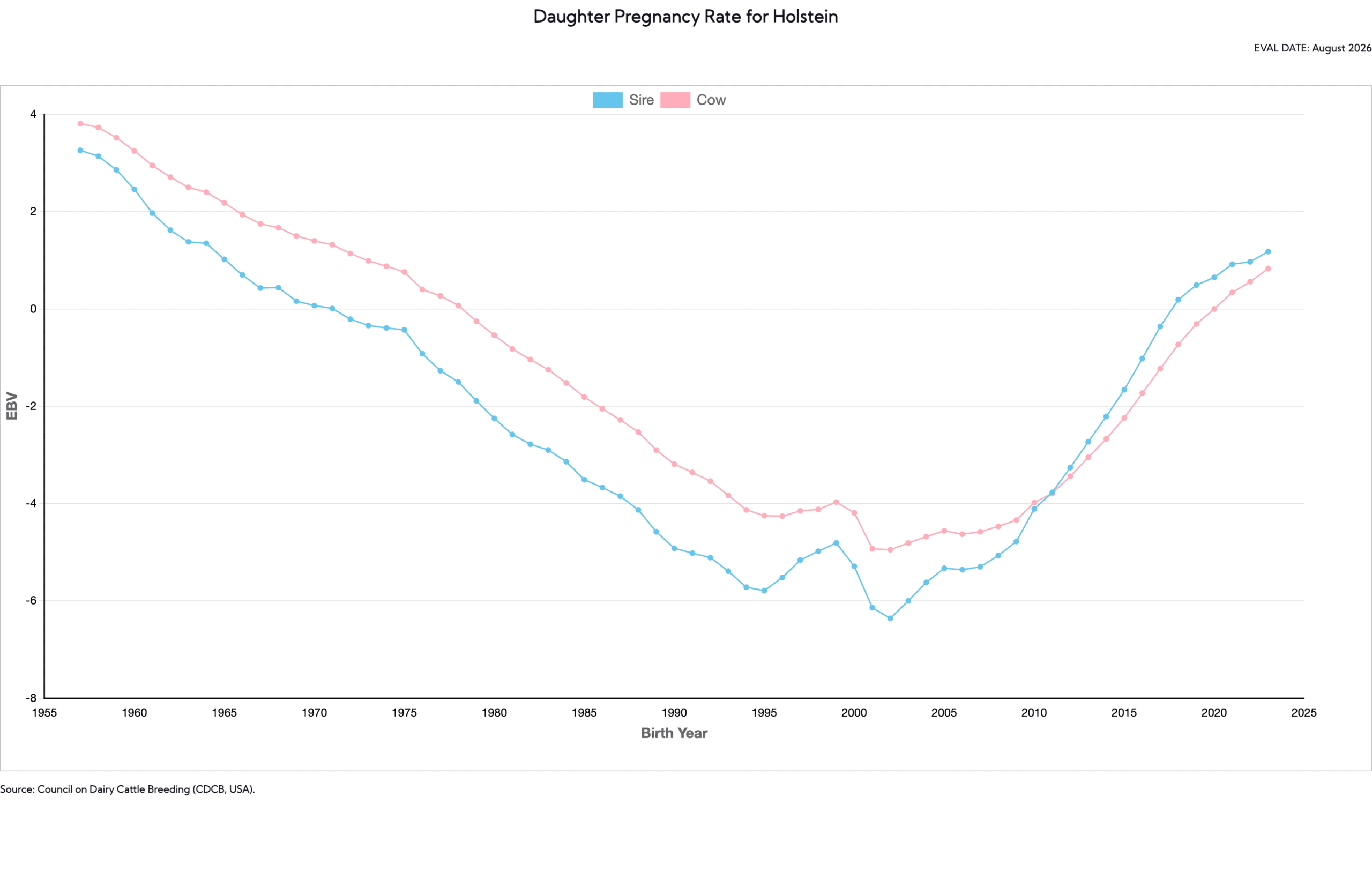
The August 2026 genetic evaluations are here – complete with three new traits, updates to legacy reproductive performance traits, and effects on correlated traits and indexes. While changes in PTA values between runs are always expected due to new cow performance data, the variation in PTAs this month goes beyond new data insights due to the updates. Additional summary statistics will be made available after bull status lists are updated on August 13.
New Traits
First Service to Conception (FSC): First Service to Conception PTA predicts a lactating cow’s genetic ability to conceive after her first insemination, measured as the number of days from first service to conception, relative to the breed base.
A positive PTA represents fewer days to conception and is more desirable. FSC is not a function of the voluntary waiting period (VWP). Find details about the trait and how it compliments other cow reproductive traits in the pre-release materials shared here.
Resistance to Respiratory Problems (RSP): Resistance to Respiratory Problems PTA represents the expected resistance of an animal’s offspring to calfhood respiratory problems.
Due to an unprecedented influx of calf health records, a few bulls have been flagged as having very high (or low) RSP PTAs. One bull in particular showed an outlier value of 22%. While results for the majority of animals are informative, this unexpected result reaffirms why new traits are not immediately added into selection indexes. The Research and Development team at CDCB is investigating to find appropriate modifications to the trait to account for effects that can now be more effectively modeled due to the substantial increase in data volume since the original research on this trait was conducted. More information will follow as it becomes available.
Resistance to Diarrhea (DIA): Resistance to Diarrhea PTA represents the expected resistance of an animal’s offspring to calfhood diarrhea.
DIA and RSP PTAs are now included in national evaluations for Holstein and Jersey males and females. Future enhancements to DIA and RSP are already under investigation, including a more refined model to account for growth in available data and a possible multi-trait analysis to share information across traits.
Revised Reproductive Performance Traits
Daughter Pregnancy Rate (DPR): Daughter Pregnancy Rate PTA predicts the expected percentage of non-pregnant cows that will become pregnant in each 21-day cycle, relative to the breed base.
The average DPR PTA for Holstein bulls (April 2026 A.I. status) increased +1.22 points between the April and August runs. This is an expected variation linked to the changes in how voluntary waiting period is considered in the trait calculation, along with other revisions to the model that better reflect modern management decisions.
Cow Conception Rate (CCR): Cow Conception Rate PTA is a female fertility trait predicting the lactating cow’s ability to conceive, defined as expected percentage to become pregnant at each insemination in comparison to the breed base.
Anticipated variation for CCR also occurred, linked to new considerations in the trait model that better account for management practices. The average PTA for Holstein bulls (April 2026 A.I. status) increased by +1.38.
Heifer Conception Rate (HCR): Heifer Conception Rate PTA is a female fertility trait predicting the maiden heifer’s ability to conceive, defined as expected percentage to become pregnant at each insemination in comparison to the breed base.
Similar adjustments in the calculation of CCR were also applied to HCR. These changes along with additional heifer performance data resulted in a decrease in average PTA by -0.14 for Holstein bulls (April 2026 A.I. status).
Early First Calving (EFC): Early First Calving PTA indicates the animal’s genetic ability to alter their female offspring’s age at first calving, defined in days compared to the breed base.
EFC was calculated in a single-trait model this evaluation. This move in computation and new cow performance data available shifted the average Holstein bull (April 2026 A.I. status) EFC PTA down -0.27 days.
Additional Affected Traits
Heifer Livability (HLV): Heifer Livability PTA predicts the difference in young female offspring expected to remain alive between 2 days after birth and 18 months of age, expressed in percentage points from the breed base.
With the addition of DIA and RSP to the evaluation system, HLV, DIA and RSP were rearranged and included in the same trait group for genomic evaluations. This is done for computational efficiency and to optimize the data set used to support all three heifer traits. HLV also included new data edits. As a result, an average decrease in PTA reliabilities for HLV compared to previous runs is to be expected.
Productive Life (PL): Productive Life PTA predicts the time that female offspring are expected to remain in the milking herd before removal by culling or death, expressed as difference in months of productivity compared to the breed base.
Productive Life is a multi-trait value – meaning data that informs PL comes from multiple other traits and sources, together with a direct measurement. PTAs and Parent Averages, and their corresponding reliabilities, are used for a multitude of traits, including reproductive traits that were updated this month, in PL calculations. Although the general increase in reproductive trait PTAs might intuitively be expected to increase PL values, the multi-trait methodology results in the opposite effect. This is linked to the changes in the emphasis of the revised reproductive traits and their contributions compared to other traits in the model. CDCB researchers are exploring opportunities to consider only direct productive life measurements in the near future.
Impact on Indexes
Net Merit $, Cheese Merit $ and Fluid Merit $: The Merit Indexes are a combination of nearly 50 traits, combined to measure economic value. Due to the list of changes and impacts above, these indexes also experience variation in this run. The combination of a slight downward trend in production traits (fat and protein) in recent birth years, plus the changes in Productive Life and Heifer Livability shift the indexes downward. However, this is countered by the positive impact of the reproductive performance traits. Overall, there is a slight decrease in NM$ values on average when comparing April and August values.
One More Item to Know
Haplotypes: There are shifts in some haplotype statuses for Holstein Calcium Deficiency (HCD) and Holsten Muscle Weakness (HMW) due to a large batch of updated female genetic tests submitted by Holstein USA to support improved haplotype estimation.
The August 2026 genetic evaluation was a significant and positive step forward for the dairy industry. The team at CDCB wants to thank everyone involved in the foundational review of the reproductive performance traits, the development of new traits, and the incredible growth in calf data to support new tools for dairy farmers.