
First Service to Conception (FSC)

Available for all breeds, FSC predicts a lactating cow’s ability to conceive and is expressed in days.

Benefits of Trait

Introduced in 2026, First Service to Conception PTA predicts a lactating cow’s genetic ability to conceive after her first insemination, measured as the number of days from first service to conception, relative to the breed base. FSC is not a function of the voluntary waiting period (VWP), and a positive PTA indicates represents fewer days to conception and is more desirable.

  • Captures fertility performance independent of VWP
  • Reflects individual cow response to modern reproductive management practices
  • Improves evaluation of fertility in herds using extended or custom VWP
  • Complements Daughter Pregnancy Rate and Cow Conception Rate by providing an interval-based measure of conception efficiency

First Service to Conception Trait

First Service to Conception is defined as the number of days from the cow’s first breeding to conception within a lactation. If the cow conceives after 200 days, FSC is set to 200. If the cow never conceives, FSC is set to 230. FSC is not a function of the VWP, which allows it to account for individual cow management independently of VWP changes.

FSC PTA predicts the expected difference, in days, from first service to conception (confirmed pregnancy) in an animal’s daughters relative to the breed base. The number of days is multiplied by -1, so a positive PTA represents fewer days to conception and is more desirable.
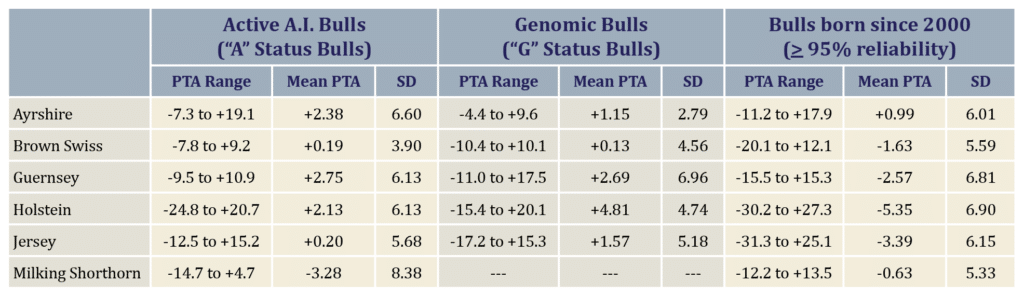
Evaluations are expressed in days.

For example, daughters of a bull with a FSC PTA of +5 are expected to take five fewer days to conceive after the first service than the breed base (mean) and daughters of a bull with a FSC PTA of -5 are expected to take five more days. The following breed means were calculated using data from the December 2025 evaluation and may vary slightly as more phenotypic data is added.

BreedBreed Mean
Ayrshire63.44 days
Brown Swiss71.94 days
Guernsey79.50 days
Holstein55.60 days
Jersey52.04 days
Milking Shorthorn47.66 days

Evaluations for FSC are provided for Ayrshire, Brown Swiss, Guernsey, Holstein, Jersey, and Milking Shorthorn (traditional only) males and females.

As a newly introduced trait, FSC is not included in the lifetime merit indexes at this time. During the next revisions, its inclusion will be evaluated.

FSC has a heritability of 3.2%. This level is typical for reproductive performance traits, indicating that genetic progress is gradual but cumulative over time.

Reliability varies by animal and is influenced by the amount of available information. Young animals typically have lower reliability, while proven sires with extensive daughter records have higher reliability.

BreedActive A.I. Bulls Reliability
Ayrshire31% to 98.2%
Brown Swiss49% to 99%
Guernsey37.7% to 93%
Holstein30.6% to 99%
Jersey58.3% to 99%
Milking Shorthorn52.1% to 89.7%

Within the reproductive performance trait portfolio, FSC is strongly correlated with Cow Conception Rate (+0.98) and Daughter Pregnancy Rate (+0.96) and moderately correlated with Heifer Conception Rate (+0.47).

These correlations allow information from related reproductive performance traits to improve evaluation accuracy, particularly when data is limited.

The data used to calculate this trait is stored in the National Cooperator Database. FSC utilizes reproductive records for lactating cows, including first insemination dates, pregnancy confirmations, and subsequent calving information reported through U.S. dairy records programs.

Most animals fall within a relatively narrow range around zero, with positive PTA indicating higher-than-average genetic potential for pregnancy rate and negative PTA indicating lower-than-average genetic potential relative to the breed base. Approximately 68% and 95% of observations fall within one and two standard deviations (SD) of the mean, respectively.

The 2026 revisions to the female reproductive performance trait portfolio, including the introduction of FSC, represents the first major delivery in an ongoing effort to keep all CDCB traits up to date with management practices and methodology. CDCB staff will continue to monitor and evaluate these and other traits, looking for opportunities to improve them over time.

Related Publications

Graham, J.R., VanRaden, P.M., McWhorter, T.M., et al. Development of a first-service-based fertility trait for U.S. dairy cattle. (In preparation).

McWhorter, T.M. et al. (2025). Foundational Review of U.S. Trait Evaluations. Interbull Bulletin.

VanRaden, P.M., Tooker, M.E., Wright, J.R., Sun, C., and Hutchison, J.L. (2014). Comparison of single-trait to multi-trait national evaluations for yield, health, and fertility. Journal of Dairy Science.

Information last updated May 1, 2026.