National Cooperator Database
CDCB manages the National Cooperator Database of phenotypic and genotypic data from 10,000 dairy herds across the U.S. and 72 countries. It is the engine that helps breed better cows.
Foundation for U.S. Genetic Evaluations
The National Cooperator Database has set the global standard for animal data, combining an unmatched quantity with robust quality standards. This database delivers value to dairy herds through genetic evaluations, management reports, and performance benchmarks that are derived from the data.
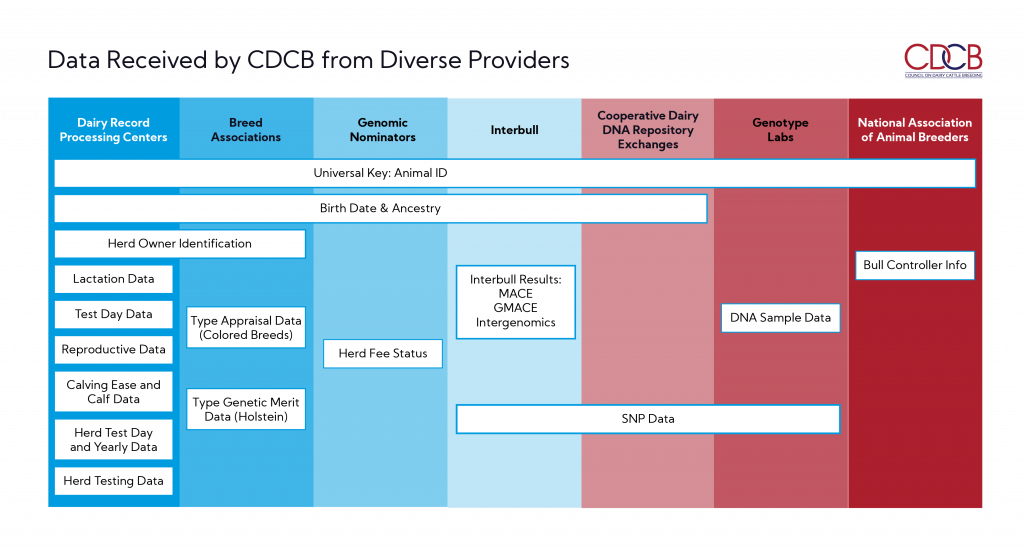
Accurate prediction of genetic values is possible through integration and analysis of various data types, like test-day milk yield, days open, health events, pedigree information, type classification, and now, genotypes. With our partners in the U.S. and globally, CDCB continues to add significant phenotypic and genotypic data that improves accuracy of evaluations and allows development of new traits.
The U.S. dairy data ecosystem is unique in agriculture and puts dairy farmers’ cow information to work for them. Read more about how this system has laid a foundation for agricultural data governance in this paper published by two agricultural economists.
National Cooperator Database Statistics
3.2mil
lactation records integrated in 2023
3.9mil
million cows in 10,300 U.S. herds on DHI (NDHIA 2023)
72
countries with animal genotypes included
11mil
animals genotyped (June 2025)
1.6mil
genotypes added in 2024
93%
of genotyped animals are female
12
breeds represented in the genotypic database
89%
of genotypes are Holstein
10%
of genotypes are Jersey
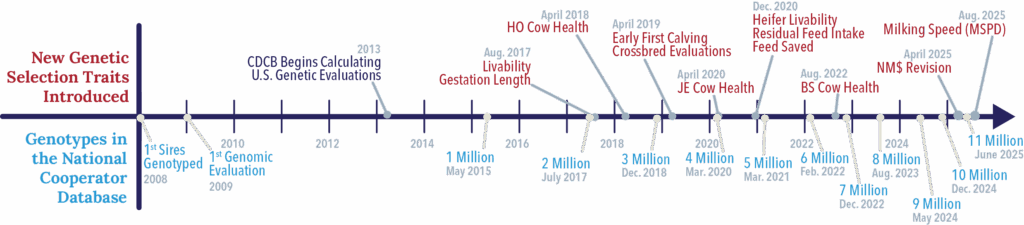
As data flows into the National Cooperator Database, new tools for genetic selection become possible. Over the last two decades, the collection of genotypes has allowed for the production of genomic evaluation traits.
Collaborative Commitment
The National Cooperator Database was built over several decades through cooperation by dairy producers, industry collaborators, international partners, and the U.S. Department of Agriculture (USDA).
Dairy producers play a pivotal role in the integrated system, providing quality phenotypic and genotypic data to the national database. By processing such information from more than 60 collaborators, CDCB returns genetic evaluations and selection tools to producers so they can improve their herds.
Genotypic and pedigree data from genotyping labs and genomic nominators – like breed associations and genetic companies – combines with phenotypic (performance) data from the Dairy Herd Improvement (DHI) system, breed associations, international partners, and research institutions.
USDA established the National Cooperator Database, which was transferred to CDCB in 2013. USDA remains a key partner through world-renowned research at the Animal Genomics and Improvement Laboratory (AGIL).

Commitment to Data Quality
Quality data is essential for quality results. CDCB has implemented a robust data quality assurance process for both phenotypic and genetic data. The National Cooperator Database is the world’s largest database devoted to dairy cattle, and a sophisticated process assures the submission of high-quality data. This combination of data quantity and quality delivers increasingly accurate predictions of genetic merit and a beneficial source for research.
Phenotypic Data Quality
U.S. animal performance, or phenotypic, data is held to high standards and quality assurance measures. Milk yield, reproductive data and health events are collected through the dairy herd improvement (DHI) system. The National Dairy Herd Information Association and Quality Certification Services sets data certification standards and secures uniform data collection procedure
Genomic Data Quality
Those that supply genotypic data – genomic nominators and genotyping labs – must be certified by CDCB before they can nominate animals and submit genotypes into the National Cooperator Database. The certification process was established in 2018. After nominators and labs are approved to participate in the system, CDCB provides monthly reports that detail performance against key metrics. Performance audits are conducted annually.
Genomic Nominators
Genomic nominators are the link between CDCB, genotyping labs, and those who wish to receive U.S. genomic evaluations on dairy animals. Their role is pivotal, with responsibility to transfer genetic material to the lab, ensure correct animal identification and sample assignment, provide pedigree and fee information to the CDCB, and distribute results to the animal’s owner.
Genomic nominators must pass CDCB quality certification standards before they can nominate animals for entry into the National Cooperator Database. Nominator performance is recorded and audited annually.
Nominator performance metrics against core requirements are monitored and reported through the CDCB Genomic Nominator Report Card and other tools to help ensure accurate information flows into the U.S. database and genetic evaluation program.
Genotyping Laboratories
Genotyping labs examine an animal’s DNA sequence through a physical specimen, like hair follicles, blood, or semen, and compare it to a reference sequence to reveal the specific alleles (genes) that an individual has inherited and can transmit to offspring.
Labs undergo a rigorous quality certification process before they are permitted to provide genotypic data to CDCB, and their performance is audited annually.
Participating genotype labs are required to be ISO certified (or equivalent). They provide Standard Operating Procedures to CDCB, and all procedures, formats, files and genotyping results are carefully reviewed. CDCB-approved labs can then provide genotypes for the National Cooperator Database. A CDCB Quality Certification is required for each genotyping technology used.
Adherence to core requirements and performance metrics, which are supported by monitoring and reporting systems like the CDCB Laboratory Report Card, are essential for accuracy in the U.S. genetic evaluation program.
Certified Genomic Partners
Explore the growing list of organizations certified to nominate male and female dairy cattle around the globe for U.S. genetic evaluations, Powered by CDCB.
Dairy Animal Identification
Unique identification for each female and male dairy animal is essential for accurate genetic evaluation. The U.S. follows the guidelines by the International Committee of Animal Recording (ICAR) to optimize data flow and global pipelines.
Learn more about official animal ID, NAAB uniform semen codes, and official country codes