August 2026 Evaluation Changes: What’s New?
Written by CDCB
July 01, 2026

The August 2026 triannual evaluation include significant updates to existing traits and a new trait for female reproductive performance evaluations along with two new calf health traits.
Female Reproductive Performance Trait Updates
Beginning with the August 2026 evaluations, CDCB will implement revisions to the genetic evaluations for Daughter Pregnancy Rate (DPR), Cow Conception Rate (CCR), Heifer Conception Rate (HCR), and Early First Calving (EFC). These updates are the result of a multi-year review of the reproductive performance evaluations and include revised trait definitions, updated data edits, and enhancements to the statistical models used to estimate genetic merit. The revisions are designed to improve the biological representation of reproductive performance, increase evaluation stability, and better utilize available reproductive data.
The three most notable revisions of the 10 included are:
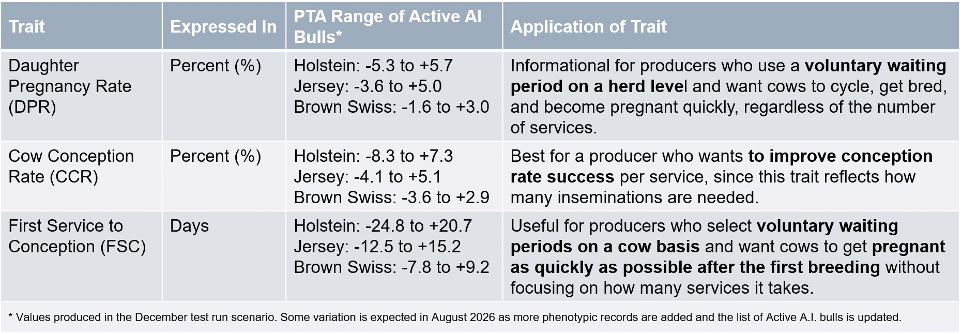
- DPR now utilizes a herd-level and lactation group-specific voluntary waiting period (VWP) rather than the previous fixed 50-day VWP. This modification removes management and environmental noise from the model that is a result of how cows are managed today compared to 2003 when the trait was first introduced. As a result, the genetic trend and PTA values for DPR are now more reflective of the genetic merit of animals.
- CCR and HCR now account for the service sire breed utilized at each insemination and short cycling. These two trait models already account for mating type (conventional semen, gender-selected, natural service, etc.). Adding service sire breed and short cycling to the models captures an additional genetic influence to conception.
- To reduce data-driven bias in young bull PTAs, daughter data is not included in DPR, CCR, and First Service to Conception (FSC) calculations until the daughter is 36 months old. This edit provides additional time for both high and moderate-to-low reproductive performance daughters to enter the evaluation closer together. As a result, an additional evaluation run or two for young bulls will be required before daughter information can influence a bull’s PTA for DPR, CCR, or FSC.
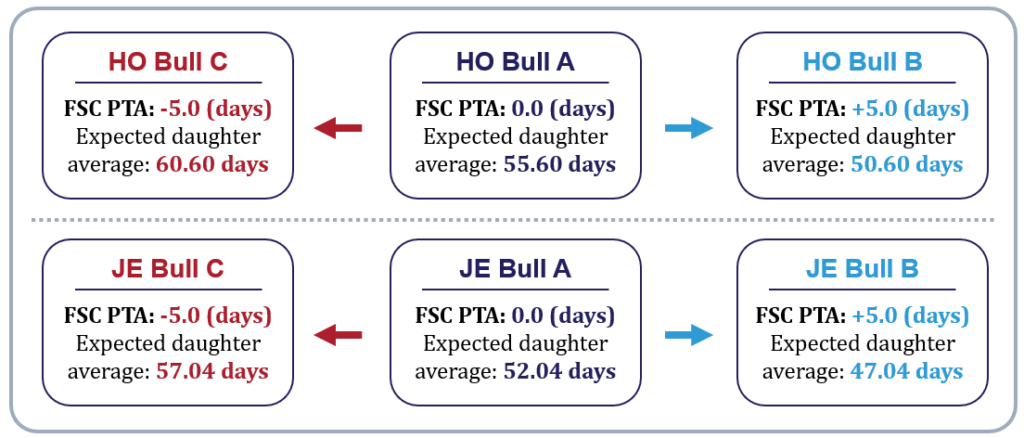
FSC is a reproductive performance trait that measures an animal’s genetic ability to achieve a successful conception in fewer days after the first insemination. FSC, to be introduced in August, provides a direct indicator of reproductive efficiency and complements the existing suite of reproductive performance evaluations. PTAs for FSC are expressed in days, with higher values indicating fewer days from first service to successful conception relative to the breed base.
How to apply and interpret the three cow-level traits
Although international (MACE) evaluations for FSC will not be used in the August CDCB evaluation, the introduction of FSC will indirectly affect how international evaluations for DPR are used domestically. Historically, when a country did not submit evaluations for the international DPR trait (“int”), CDCB used the values reported for trait “cc2” as a substitute. Beginning in August, however, trait “cc2” will contain FSC rather than DPR. Because FSC and DPR are distinct traits, this substitution will no longer be possible. As a result, some foreign bulls will no longer receive an international DPR value through this substitution. The largest impacts will be seen in bulls from Switzerland, New Zealand, Australia, the Czech Republic, and Israel.
New Calf Health Traits
The August 2026 evaluations will also introduce two new calf health traits: Resistance to Diarrhea (DIA) and Resistance to Respiratory Problems (RSP). These evaluations are based on producer-recorded calf health data collected through Dairy Herd Improvement (DHI) programs and provide genetic predictions for resistance to two of the most common health challenges affecting young calves.
PTAs for DIA and RSP are expressed in percentage points, with higher values indicating greater genetic resistance to disease. The new evaluations expand CDCB’s portfolio of health traits and provide dairy producers with additional tools to improve calf health, survivability, and long-term herd performance through genetic selection.
For complete technical details, anticipated impacts, and supporting resources, visit uscdcb.com/august-2026-evaluations.