
Heifer Conception Rate (HCR)

Available for all breeds, HCR predicts a maiden heifer’s ability to conceive and is expressed as a percentage.

Benefits of Trait

Introduced in 2009 and updated in 2026, Heifer Conception Rate PTA predicts the expected difference in conception rate of daughters as maiden heifers relative to the breed base. The 2026 revision updates the model to account for service sire breed, mating type, and short cycling (an insemination that takes place 10 to 17 days after the previous insemination).

  • Improves genetic selection for successful conception in replacement heifers
  • Supports timely age at first calving and efficient heifer development
  • Reduces breeding costs associated with repeated inseminations
  • Complements cow reproductive performance traits by capturing reproductive performance before first calving

Heifer Conception Rate Trait

Heifer Conception Rate is defined as the proportion of inseminations that result in pregnancy for an individual heifer, based on outcomes for up to the first seven inseminations. HCR PTA predicts the expected difference in conception rate of an animal’s daughters as maiden heifers relative to the breed base.

HCR is calculated using up to seven inseminations (0 for failure; 1 for success). These inseminations are adjusted for mating type, service sire breed, and short cycling, then used to calculate a conception rate by dividing by the total number of inseminations required.
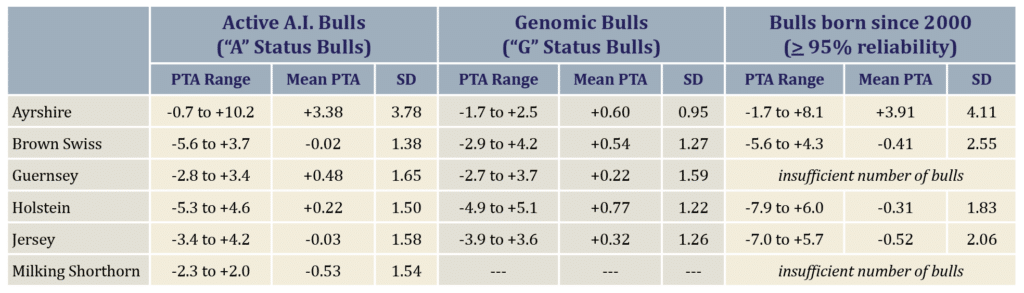
Evaluations are expressed in percentages.

For example, daughters of a bull with a HCR PTA of +1 are expected to have an average conception rate 1% higher than the breed base (mean).

Evaluations for HCR are provided for Ayrshire, Brown Swiss, Guernsey, Holstein, Jersey, and Milking Shorthorn (traditional only) males and females.

HCR has been included in the lifetime merit indexes since 2014. As of the April 2025 update to the indexes, HCR has the following relative emphasis in each:

  • NM$: 0.5%
  • CM$: 0.5%
  • FM$: 0.5%
  • GM$: 0.9%

These values represent HCR’s economic importance to reproductive efficiency and herd profitability. The August 2026 modifications to HCR do not affect these emphases because the weights on traits in the lifetime me

HCR has a heritability of 1.4%. This level is typical for reproductive performance traits, indicating that genetic progress is gradual but cumulative over time.

Reliability varies by animal and is influenced by the amount of available information. Young animals typically have lower reliability, while proven sires with extensive daughter records have higher reliability.

BreedActive A.I. Bulls Reliability
Ayrshire32% to 87%
Brown Swiss50% to 95%
Guernsey19% to 69%
Holstein19.4% to 99%
Jersey41.4% to 99%
Milking Shorthorn27.7% to 49.9%

Within the reproductive performance trait portfolio, HCR is moderately correlated with Daughter Pregnancy Rate (+0.56), Cow Conception Rate (+0.52), and First Service to Conception (+0.47).

These correlations allow information from related reproductive performance traits to improve evaluation accuracy, particularly when data is limited.

The data used to calculate this trait is stored in the National Cooperator Database. HCR utilizes reproductive records for maiden heifers, including insemination events, pregnancy diagnoses, and subsequent calving confirmations reported through U.S. dairy records programs.

Most animals fall within a relatively narrow range around zero, with positive PTA indicating higher-than-average genetic potential for pregnancy rate and negative PTA indicating lower-than-average genetic potential relative to the breed base. Approximately 68% and 95% of observations fall within one and two standard deviations (SD) of the mean, respectively.

Related Publications

Hutchison, J.L., VanRaden, P.M., Norman, H.D., and Cole, J.B. Technical note: Changes to herd cutoff date in conception rate evaluations. J. Dairy Sci. 96(2):1264–1268. 2013.

Kuhn, M.T., Hutchison, J.L., and Wiggans, G.R. (2006). Characterization of Holstein heifer fertility in the United States. Journal of Dairy Science.

McWhorter, T.M. et al. (2025). Foundational Review of U.S. Trait Evaluations. Interbull Bulletin.

Miles, A.M., Hutchison, J.L., and VanRaden, P.M. Improving national fertility evaluations by accounting for the rapid rise of embryo transfer in US dairy cattle. J. Dairy Sci. 106(7):4836-4846. 2023.

Norman, H.D., Hutchison, J.L., VanRaden, P.M., and Cole, J.B. (2008). Genetic evaluation of heifer conception rate. Journal of Dairy Science.

VanRaden, P.M., Tooker, M.E., Wright, J.R., Sun, C., and Hutchison, J.L. Comparison of single-trait to multi-trait national evaluations for yield, health, and fertility. J. Dairy Sci. 97(12):7952-7962. 2014.

Information last updated May 1, 2026.