
Early First Calving (EFC)

Available for all breeds, EFC predicts an animal’s ability to alter their daughters’ age at first calving.

Benefits of Trait

Introduced in 2019 and updated in 2026, Early First Calving PTA predicts an animal’s genetic ability to influence the age at which its daughters have their first calving, relative to the breed base. The 2026 revision moves the calculation of EFC to a single-trait model.

  • Supports early reproductive maturity in replacement heifers
  • Contributes to improved lifetime productivity and herd efficiency
  • Reduces nonproductive days prior to first lactation
  • Complements conception-based reproductive performance traits by capturing timing of reproductive onset

Early First Calving Trait

EFC is defined and calculated as the number of days from a heifer’s birth to her first calving.

EFC PTA predicts the expected difference, in days, in age at first calving of an animal’s female offspring relative to the breed base. The number of days is multiplied by -1, so a positive PTA represents fewer days to first calving and is more desirable.
Evaluations are expressed in days.

For example, daughters of a bull with an EFC PTA of +5 are expected to calve for the first time at 5 days younger than the breed base (mean). The following breed means were calculated using data from the December 2025 evaluation and may vary slightly as more phenotypic data is added.

BreedBreed Mean
Ayrshire821.78 days (27.4 months)
Brown Swiss801.49 days (26.7 months)
Guernsey803.95 days (26.8 months)
Holstein723.47 days (24.1 months)
Jersey693.39 days (23.1 months)
Milking Shorthorn802.12 days (26.7 months)

Evaluations for EFC are provided for Ayrshire, Brown Swiss, Guernsey, Holstein, Jersey, and Milking Shorthorn (traditional only) males and females.

EFC has been included in the lifetime merit indexes since 2021. As of the April 2025 update to the indexes, EFC has the following relative emphasis in each:

  • NM$: 1.0%
  • CM$: 1.0%
  • FM$: 1.0%
  • GM$: 0.8%

These values represent EFC’s economic importance to reproductive efficiency and herd profitability. The August 2026 modifications to EFC do not affect these emphases because the weights on traits in the lifetime merit indexes are based on economic values that are not being updated. Animal variations in NM$, CM$, FM$, and GM$ that are expected with the updates to EFC will be due to changes in PTA values because of the reformulation, not the relative emphasis of the trait in the index.

EFC has a heritability of 6.0%. This is higher than the other reproductive performance traits, indicating meaningful genetic variation for age at first calving.

Reliability varies by animal and is influenced by the amount of available information. Young animals typically have lower reliability, while proven sires with extensive daughter records have higher reliability.

BreedActive A.I. Bulls Reliability
Ayrshire27% to 94.8%
Brown Swiss33% to 97%
Guernsey24% to 77%
Holstein24.3% to 99%
Jersey43.7% to 99%
Milking Shorthorn29.1% to 69.7%

EFC is treated as uncorrelated with the other reproductive performance traits. This reflects that EFC captures age-related reproductive timing rather than insemination success.

The data used to calculate this trait is stored in the National Cooperator Database. EFC utilizes calving records, including birth dates and first calving dates, reported through U.S. dairy records programs.

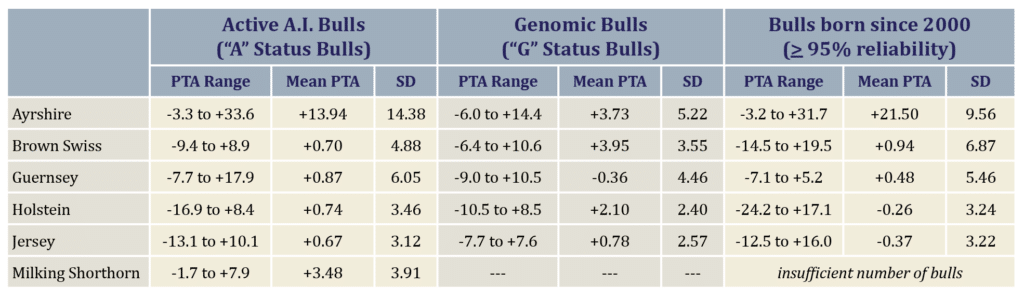
Most animals fall within a relatively narrow range around zero, with positive PTA indicating higher-than-average genetic potential for pregnancy rate and negative PTA indicating lower-than-average genetic potential relative to the breed base. Approximately 68% and 95% of observations fall within one and two standard deviations (SD) of the mean, respectively.

Related Publications

McWhorter, T.M. et al. (2025). Foundational Review of U.S. Trait Evaluations. Interbull Bulletin.

Information last updated May 1, 2026.